

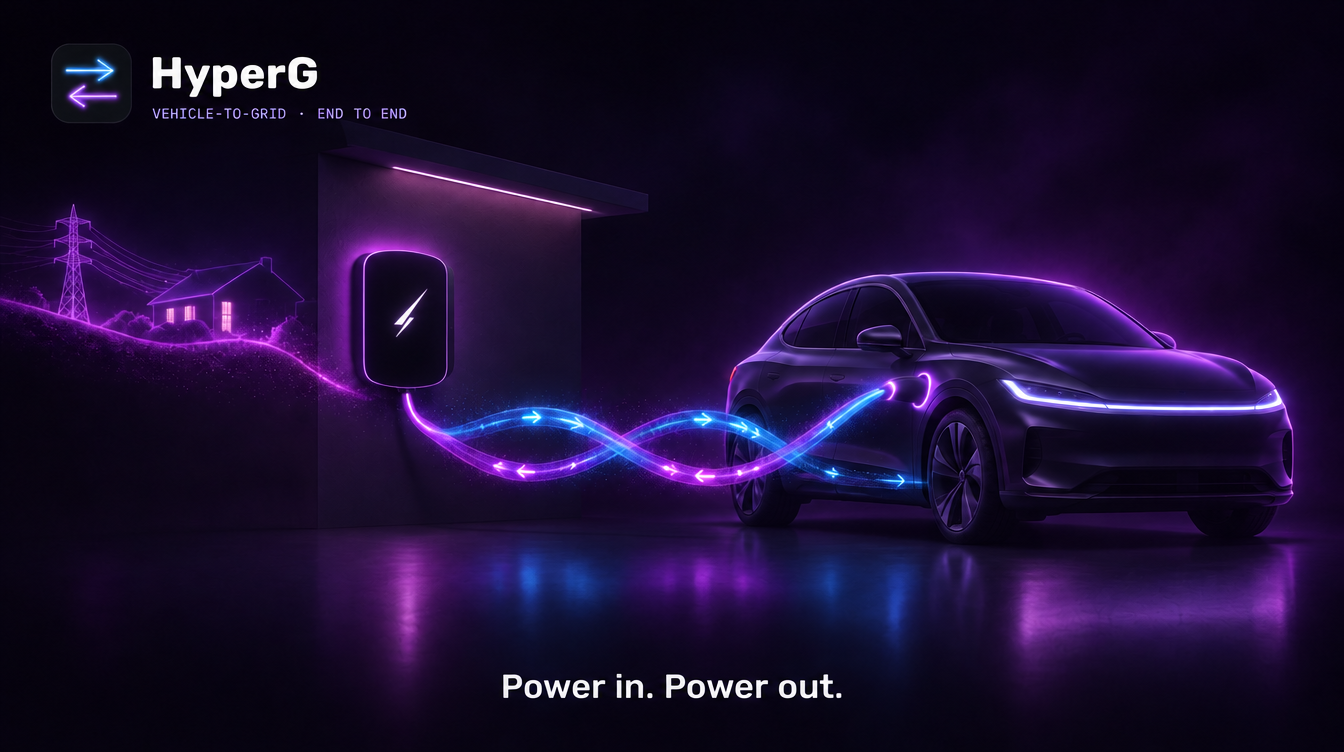
LONDON — 23 November 2026 — An electric car is a very large battery on wheels, and most of the day it sits parked. Vehicle-to-grid puts that battery to work. The car charges when energy is plentiful, and gives power back to the home and the grid when it is needed. Today Hypervolt is showing it working, start to finish, on a Hypervolt V4 charger.
Three weeks ago Hypervolt introduced HyperG, the software that lets a charger and a car understand each other. This is HyperG doing what it was built to do.
See it in action.
A complete vehicle-to-grid session on a Hypervolt V4 charger, in a little over three minutes. Also on YouTube.
Plug in. That’s it.
In the video, a Hypervolt V4 charger is connected to professional test equipment from Keysight that behaves exactly like an electric car. One press starts everything.
The charger and the car find each other through the charging cable. They set up a secure, private connection. They confirm who is paying. They agree how much power to move, and in which direction. There is no app to open and no card to tap. The cable is all it takes.
Ready in seconds.
to set up the session
to approve the car
to start the power
A charger and a car have a lot to agree on before any energy moves. With HyperG, that whole conversation is over almost before you notice it. Finding each other over the cable took 1.75 seconds. Everything after that took less than two.
Power in. Power out.
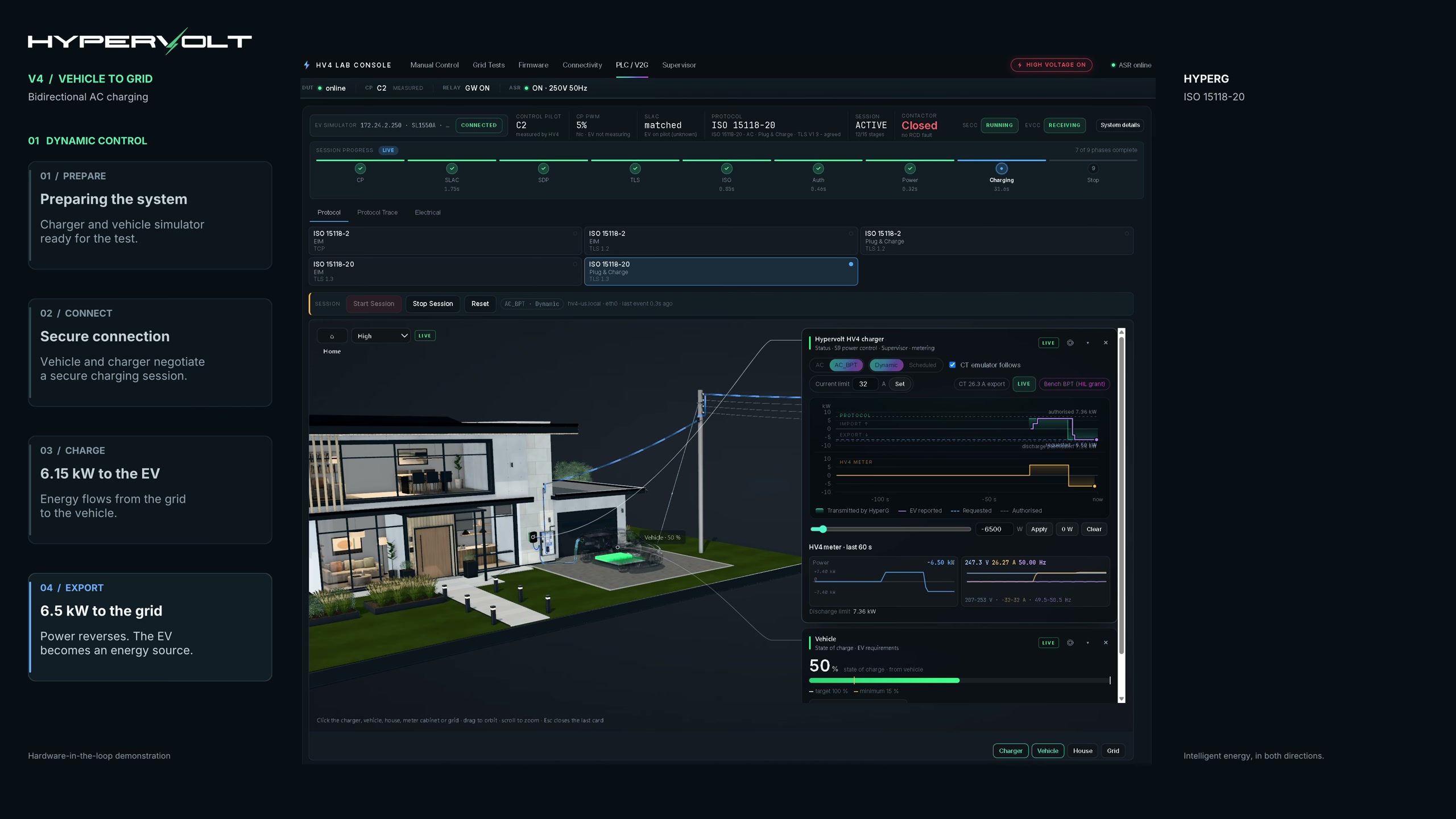
The car sending 6.5 kW back. The energy path turns from green to blue when power flows out of the car.
First the car charges, at 6.15 kW. Then, with one move of a slider, the flow turns around, and 6.5 kW travels from the car back to the home and the grid.
The cable stays in. The session never stops. The car simply goes from using energy to supplying it.
And none of it is an estimate. The charger measures the power itself, and what it measures matches what was asked for.
It follows a plan.
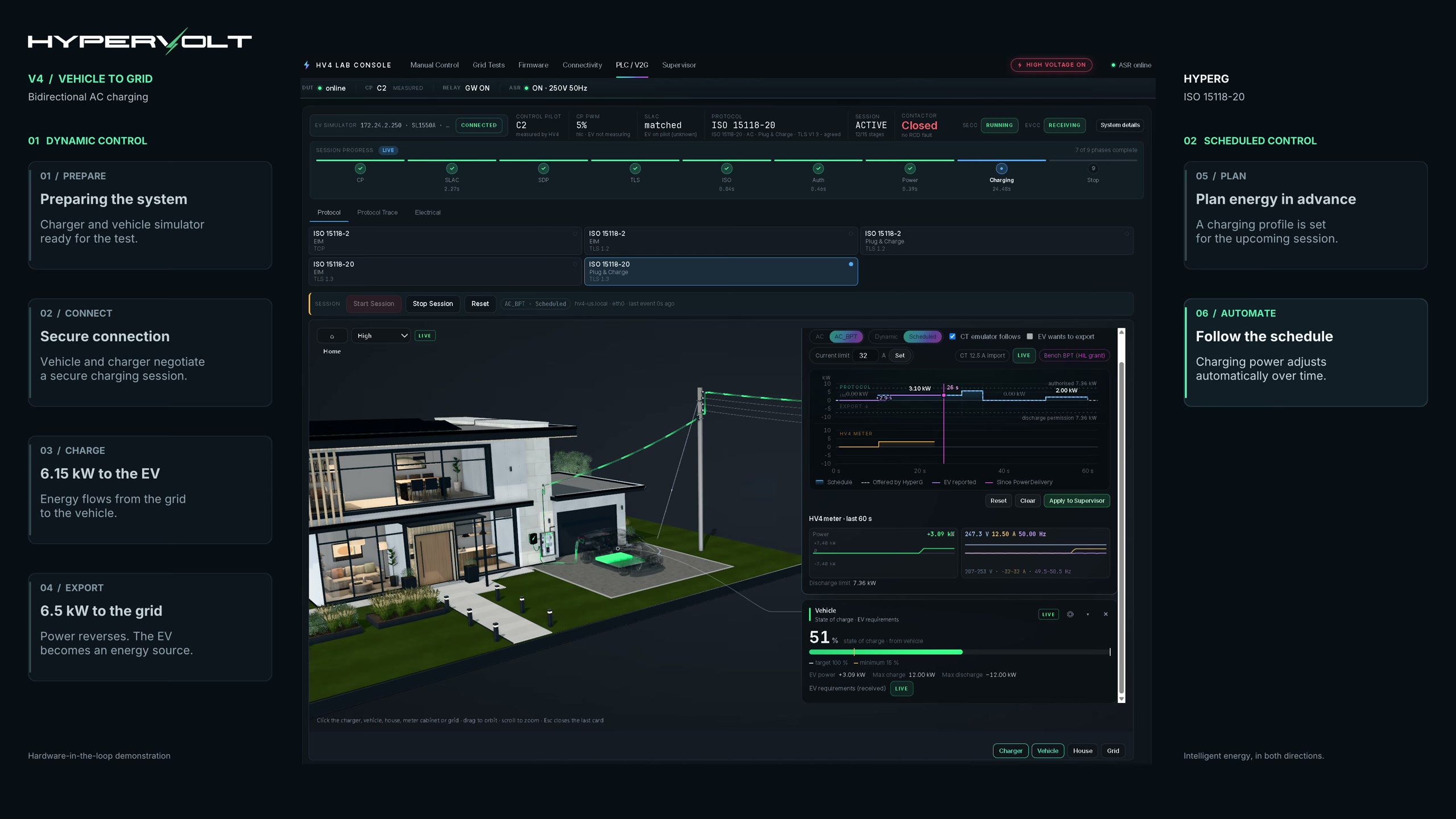
The plan is set in advance, and the car follows it step by step.
Energy is not the same price, or equally clean, at every hour of the day. So the second half of the video shows the car following a plan agreed in advance.
Charge a little. Charge more. Ease off. Stop completely, then start again. All of it happens on its own, without unplugging and without losing the connection. That is what lets a car wait for a better moment, or make room for the rest of the home, and carry on when the time is right.
The whole home, at a glance.
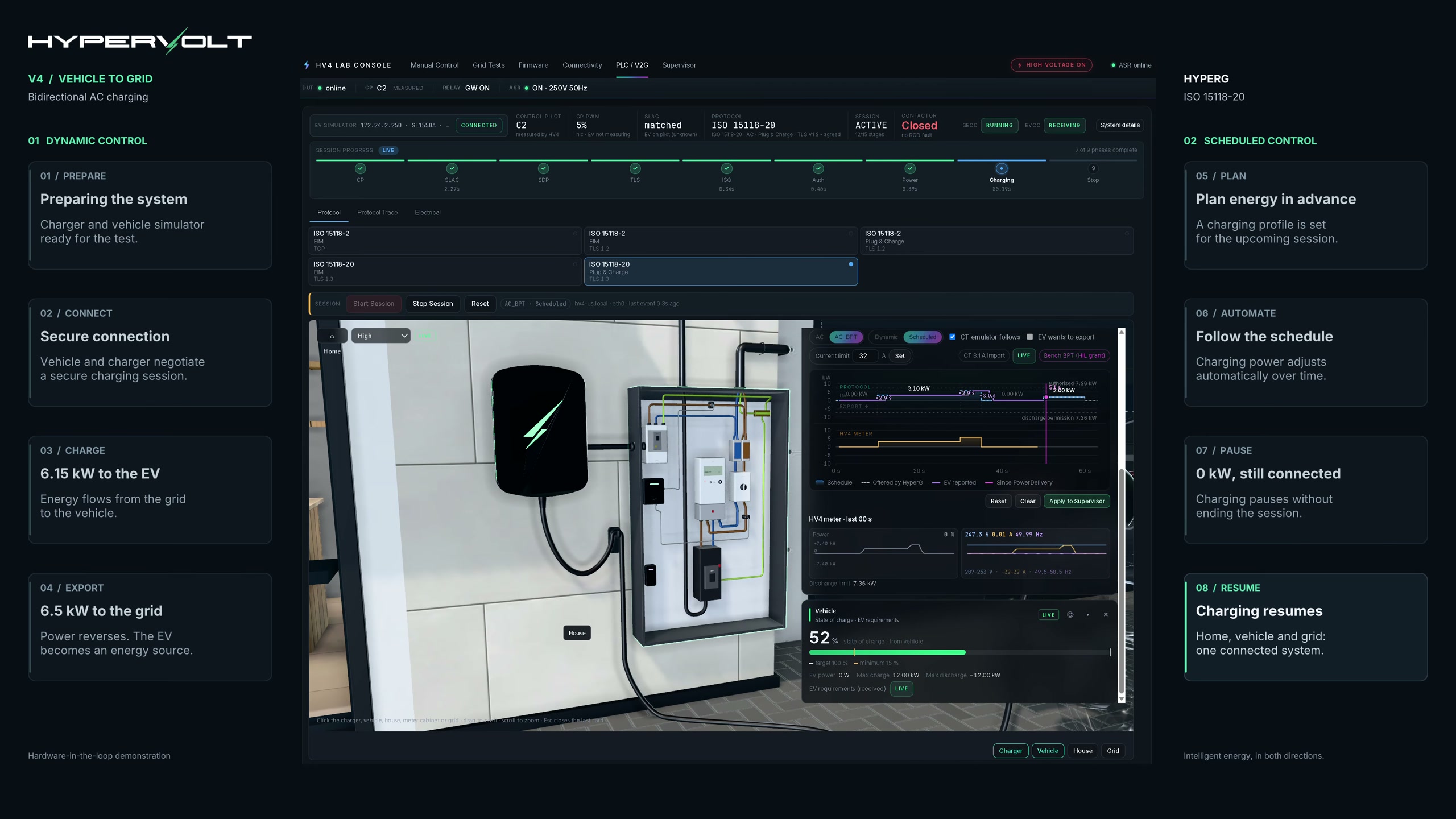
The charger and the home’s electrical cabinet in HyperG Lab.
The software in the video is HyperG Lab, built by Hypervolt to test vehicle-to-grid. It shows a home in 3D: the house, the charger, the car and the grid, with energy moving between them as it happens. Green when the home is taking power. Blue when the car is giving it back.
Click on anything to see what it is doing right now, from how full the car’s battery is to how much power the charger is moving.
Built in-house. Ready now.
Every car maker builds vehicle-to-grid a little differently. Hypervolt wrote HyperG itself and built HyperG Lab to test it, so a new car can be connected, tested and tuned quickly, without waiting on anyone else.
Vehicle-to-grid is available in HyperG today. It was built entirely in-house, and it has been proven on Hypervolt V4 hardware against industry-standard Keysight test equipment.
The details.
For those who want the numbers behind the video.
How to get in touch.
Working on vehicle-to-grid, or want to see HyperG run against your own hardware? Hypervolt would like to hear from you.
Bidirectional charging, ISO 15118-20 integration and interoperability testing.
The walkthrough is a hardware-in-the-loop demonstration recorded on a lab bench. The charger is real Hypervolt V4 hardware running HyperG. The vehicle side is a Keysight EV simulator, professional test equipment for EV charging, and the grid is simulated. Timings and power figures are those of the recorded session and will vary by vehicle and installation. ISO 15118-20 vehicle-to-grid is available now in HyperG: fully implemented, developed entirely in-house by Hypervolt, and validated end to end on Hypervolt V4 hardware against industry-standard Keysight test equipment.
Join the discussion
Share your thoughts and questions with the community.
Comments are moderated. Your email address will not be published.